
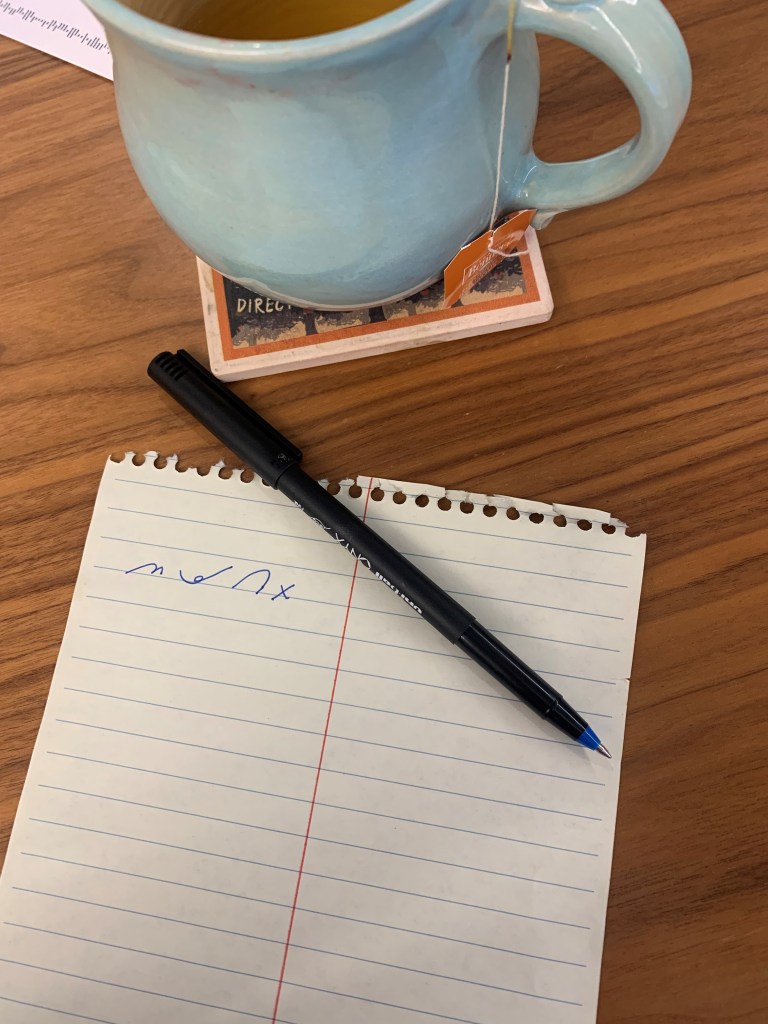
shorthand – noun
1. a method of rapid handwriting using simple strokes, abbreviations, or symbols that designate letters, words or phrases (distinguished from longhand)
http://www.dictionary.com
It was the end of my sophomore year in high school when I registered for my junior year of classes. For a number of reasons, Shorthand and Typing seemed to be useful electives for me. Taken together, the two classes would merit one full major credit.
Other students I spoke with felt those business skills would become valuable in the future — not only for stable office jobs but also for typing up school term papers.
In the end, shorthand did become a beneficial tool for me. For example, I’m impatient by nature, so being able to quickly take notes in Gregg Shorthand makes me very happy indeed.
By the following Fall, I sat in my first Gregg Shorthand class and was already feeling intimidated. For starters, due to the seating chart being designed in alphabetical order, I was placed in the second seat from the front row. This was new to me, since I typically sat in the back of the class — either my height dictated that choice, or the fact that my last name starts with the letter V. Up at the front of the class, I felt exposed. A bit vulnerable. What if I was put on the spot and couldn’t provide an acceptable answer? There I’d sit for the entire class to see my ignorance.
Except the first day of class proved to be both challenging and exciting, since our teacher — Mrs. Lynn Sanders — ensured our class that we’d be writing words in shorthand by the end of that very first session. She explained that Gregg Shorthand replaces letters with symbols for actual sounds. That very morning, we learned the symbols for S, F, V and A.
With those four symbols, we could already write the words: save; as; save; safe; face; and vase.
I immediately fell in love with the system!
I excelled at shorthand.
Three months later, I was beginning to feel like Teacher’s Pet, as Mrs. Sanders took a liking to me. And why not? I always handed in my homework. I could read and transcribe my shorthand notes with ease. My speed that first year were over 80 words per minute… an easy grade A for me.
There was one caveat… The only fault Mrs. Sanders found with me was that I was routinely late to her class, walking in the door 4-5 minutes after her session started.
I didn’t like to be penned in with restrictions. It all started way back in grade school when we lived kitty-corner from our grade school. My siblings and I would wait for the first bell to ring before we burst out our back door and ran across the street to line up with our respective classmates. It drove our mother nuts, but we didn’t see the logic in waiting around any longer than we needed to. Rules, schmules.
By the time I started high school, my bad habits were already in place. For the most part, Mrs. Sanders and I got along quite well, and I thought I had her eating out of the palm of my hand.
Until that one afternoon when Mrs. Sanders made a telephone call home to my mother. She asked my mom to ensure that I start arriving on time to my morning class. Naturally, my mother agreed with her.
The next morning, my mom insisted that I catch an earlier bus to school — an outrageous idea to me. Yet there I found myself walking to the bus stop 30 minutes earlier than my usual practice. I mumbled and grumbled to myself the entire way in.
That morning I was one of the first students at the classroom door. When our teacher approached with keys to unlock the door, she slyly winked at me. “Good morning everyone,” she smiled.
“Good Morning Mrs. Sanders,” we chorused together.
I rolled my eyes and headed toward my seat. Truth is, though, I still liked her.
Mrs. Sanders always believed in me.
“You can do it!” was her favorite phrase. And I believed her. She had so much faith in my abilities that she sent me downtown to participate in a shorthand contest hosted by the City Colleges of Chicago. And, of course, I couldn’t let her down.
A couple weeks later I hopped onto the Dan Ryan Flyer (CTA’s Red Line to you younger readers) to make my way downtown for the shorthand transcription competition. Not entirely sure of where the Loop College was located, I got off the El when I saw a sign for the Marshall Field’s building. At my age, I had no clue where I was going. I asked several strangers on the street for directions, but no one could assist. Finally, a police officer pointed me in the right direction.
I ran toward the college and entered its lobby filled with unease. Out of breath from running, I stopped at the front desk. “Do you know where the shorthand competition is?” I asked in a trembling voice. My shyness certainly had the best of me that morning.
Ninety minutes later, I walked out of that school holding a plaque for taking third place. I couldn’t wait to tell Mrs. Sanders!
My shorthand skills stayed strong while I was in school. Mrs. Sanders even arranged for a reporter on our school newspaper to write a short column about my experience at the contest. I blushed. Yet I still keep that winning plaque today.
Big dreams soon dashed…
One year later, I graduated and set my sights on landing a super-duper secretarial post in downtown Chicago, where I could utilize my extraordinary shorthand skills.
One of the first real jobs I had was working for the oldest law firm in the city: Winston & Strawn. Winston had impressive partners and political connections. I felt confident that I could be successful in its demanding legal environment. After all, didn’t I once win a shorthand contest?
During the first week of employment at Winston & Strawn, I found myself filling in for a partner while his secretary was on vacation. He called me in his office to dictate a letter. “Here’s my chance to shine,” I told myself. Unfortunately, once I started transcribing my notes, I became stuck on a couple of words. (Please understand, dear readers, that the faster a stenographer writes, the sloppier their work becomes.)
I didn’t have anyone nearby to ask for help. It was all on me, and I couldn’t figure out those two darned words. Mrs. Sanders had taught us to rely on our memory when we ran into this type of situation. But since I was a novice in the legal industry, I wasn’t having any luck with typical legal jargon.
I thought I’d be a bit silly and lighten the mood in that austere office environment. I went ahead and typed what I thought my notes read: shop class. There! I handed him the draft letter, hoping he’d get a good chuckle and handwrite in the correct words.
He was not amused.
That’s supposed to be “separate correspondence,” the attorney barked at me.
Clearly, he wasn’t in a joking mood.

Even today’s notes gave me trouble
Fifteen or so years went by. I was successful in my job. And (most) of my shorthand was transcribed with positive results. That’s when I ran into a friend from high school, who sadly informed me that our Mrs. Sanders had passed away.
I was surprised to hear that depressing news. Mrs. Sanders was only in her 50’s. What happened? Was she ill? Except there were no more details available.
Mrs. Sanders was a wonderful and inspiring teacher. I know she also taught English, where some of her pupils didn’t view her with the same rose-colored glasses. To me, however, she was strict for a reason. She wanted her students to push themselves beyond their limits and excel.
Therefore, today’s post is dedicated to you, Lynn Sanders. Thank you for believing in me. Thank you for pushing me to do my best. Thanks (a lot!) for calling my mother and putting an end to my lateness.
I’m so glad you did so.
Thank you for reading – PIZZA FOR BREAKFAST


 PIZZA FOR BREAKFAST
Too bad shorthand is a lost art, now. Can you still take it? BTW: I read your shorthand: “Can you read this?”
LikeLike
Hey Rhonda… Yep, I use it daily to jot down my notes at work. 🙂
LikeLike
I love this Heidi! Mrs. Sanders was the best.
“Can you read this?” On your stenopad.
LikeLiked by 1 person
Hi Mary, yeah she was pretty cool!
LikeLike
Teacher appreciation never goes out of style and us bever stressed enough! Nice memory. CJCJ Martello – 11403 S. St. Lawrence Ave, Chicago IL, 60628 – res:773-701-6756 Do not listen with the intent to reply, but with the intent to understand.
LikeLiked by 1 person
Thanks for being a faithful reader, CJ. Always good to hear from a fellow writer.
LikeLike